Here is another posting from the project that we blogged about last September. This one is by the homeowner of the project, and there is a lot of great detail and pictures. A potential client made us aware of this posting, so thank you to her. It contains a very nice quote for us. It is worth taking a look.
http://ths.gardenweb.com/forums/load/kitchbath/msg021146581885.html
Wednesday, June 20, 2012

Monday, October 24, 2011
Quality Resawn Timbers Create Exceptional Antique Flooring
Why Not Get Your Wood Floor at a Big-Box Retailer?
If you can find 10-inch, wide-plank, 16-foot-long pieces of wood that are not bowed or cupped at a big-box store, by all means, buy it. That’s what Sarah Londerville, co-owner of Manomin Resawn Timbers, says in this video about Manomin’s quality.
You’re not likely to find such big, long, wide, high-quality boards at the new-wood retailers, and they certainly won’t be the gorgeous, unique reclaimed wood you find at Manomin Resawn Timbers.
What You See is What You Get.
Manomin is proud of our attention to detail. The reclaimed wood product you see in our showroom, at the home shows we attend (come see us at the AIA Minnesota Convention for Architects and Designers November 9-10 or the Midwest Home Show Nov 18-20 in Minneapolis!), and the reclaimed antique wood samples you’ll see at our dealers is exactly what gets delivered to your home.

Manomin Resawn Timbers mills its wide-plank flooring from reclaimed, antique lumber and timbers from 19th- and 20th-century structures, old barns, warehouses and factories. This antique wood has a warmth and patina only found in reclaimed wood. Manomin also offers reclaimed wood paneling, timbers, box beams and mantels. Antique lumber inspires a fresh and innovative style for your home, office or business.
Quality Processes. Exceptional Antique Wood Flooring.
Mark Clasen, co-owner of Manomin Resawn Timbers, explains in the video how most of Manomin’s reclaimed wood material is re-sawn on-site into whatever dimension you need. Then it’s put into the kiln to re-stabilize. Even though the timbers have been drying for 100+ years — we still want to make sure our reclaimed antique wood is down to the right moisture content. It’s all part of our quality process. From there we run it through the straight-line ripsaw, plane the backs, run it through our moulder and defect it.

By following this quality process, we ensure that your Manomin Resawn Timbers reclaimed wood product will all be useable when it arrives. No waste. And we guarantee every floor. If you install your Manomin reclaimed antique wood floor the way we direct you to install it, we know there won’t be any issues. We have exceptional success with our reclaimed wood products.
Watch the video for more details and a glimpse at our operation. Then come to our show room at 15152 Freeland Avenue in Hugo, MN to experience our reclaimed wood for yourself. We look forward to meeting you.
If you can find 10-inch, wide-plank, 16-foot-long pieces of wood that are not bowed or cupped at a big-box store, by all means, buy it. That’s what Sarah Londerville, co-owner of Manomin Resawn Timbers, says in this video about Manomin’s quality.
You’re not likely to find such big, long, wide, high-quality boards at the new-wood retailers, and they certainly won’t be the gorgeous, unique reclaimed wood you find at Manomin Resawn Timbers.
What You See is What You Get.
Manomin is proud of our attention to detail. The reclaimed wood product you see in our showroom, at the home shows we attend (come see us at the AIA Minnesota Convention for Architects and Designers November 9-10 or the Midwest Home Show Nov 18-20 in Minneapolis!), and the reclaimed antique wood samples you’ll see at our dealers is exactly what gets delivered to your home.

Manomin Resawn Timbers mills its wide-plank flooring from reclaimed, antique lumber and timbers from 19th- and 20th-century structures, old barns, warehouses and factories. This antique wood has a warmth and patina only found in reclaimed wood. Manomin also offers reclaimed wood paneling, timbers, box beams and mantels. Antique lumber inspires a fresh and innovative style for your home, office or business.
Quality Processes. Exceptional Antique Wood Flooring.
Mark Clasen, co-owner of Manomin Resawn Timbers, explains in the video how most of Manomin’s reclaimed wood material is re-sawn on-site into whatever dimension you need. Then it’s put into the kiln to re-stabilize. Even though the timbers have been drying for 100+ years — we still want to make sure our reclaimed antique wood is down to the right moisture content. It’s all part of our quality process. From there we run it through the straight-line ripsaw, plane the backs, run it through our moulder and defect it.

By following this quality process, we ensure that your Manomin Resawn Timbers reclaimed wood product will all be useable when it arrives. No waste. And we guarantee every floor. If you install your Manomin reclaimed antique wood floor the way we direct you to install it, we know there won’t be any issues. We have exceptional success with our reclaimed wood products.
Watch the video for more details and a glimpse at our operation. Then come to our show room at 15152 Freeland Avenue in Hugo, MN to experience our reclaimed wood for yourself. We look forward to meeting you.
Friday, September 30, 2011
Should you be a Manomin Customer?
Do you take pride in your home and/or business? Would you like to create a look and feel — an experience — people remember after they’ve visited? Does the richness of real wood appeal to you? Do you settle for nothing less than the best? If you answered, “yes” to any or all of these questions, then Manomin Resawn Timbers may be the right company for you.
Known for reclaimed wood, particularly wide-plank antique wood flooring, Manomin provides customers with truly exceptional products. In this video, Mark Clasen and Sarah Londerville, co-owners of Manomin Resawn Timbers, talk about working with clients.
Whether people find us at tradeshows like the Midwest Home Show, direct mail, our website or even Twitter, they come to Manomin because they’re looking for the best in antique flooring or extraordinary reclaimed antique wood finishes on furniture or other custom projects. Our customers are designers, builders and architects as well as end users who are building or remodeling a home or business. They bring their blueprints and photos, and we bring years of experience and a variety of reclaimed wood options to consult on and create the perfect solution for each person.
Each style of reclaimed wood has it’s own look and feel, from reclaimed antique oak that we skip-plane to wide-plank Douglas fir coming out of a timber stock to antique elm for a more formal look. We need to understand your style and the experience you’re trying to create, and then we can bring the right reclaimed wood to the table — or mantle, or staircase, or paneling, or floor — whatever the case may be.
We invite you to watch the video or look through the gallery, but to truly experience the Manomin difference, you have to come to our show room at 15152 Freeland Avenue in Hugo, MN. We look forward to meeting you soon!
Known for reclaimed wood, particularly wide-plank antique wood flooring, Manomin provides customers with truly exceptional products. In this video, Mark Clasen and Sarah Londerville, co-owners of Manomin Resawn Timbers, talk about working with clients.
Whether people find us at tradeshows like the Midwest Home Show, direct mail, our website or even Twitter, they come to Manomin because they’re looking for the best in antique flooring or extraordinary reclaimed antique wood finishes on furniture or other custom projects. Our customers are designers, builders and architects as well as end users who are building or remodeling a home or business. They bring their blueprints and photos, and we bring years of experience and a variety of reclaimed wood options to consult on and create the perfect solution for each person.
Each style of reclaimed wood has it’s own look and feel, from reclaimed antique oak that we skip-plane to wide-plank Douglas fir coming out of a timber stock to antique elm for a more formal look. We need to understand your style and the experience you’re trying to create, and then we can bring the right reclaimed wood to the table — or mantle, or staircase, or paneling, or floor — whatever the case may be.
We invite you to watch the video or look through the gallery, but to truly experience the Manomin difference, you have to come to our show room at 15152 Freeland Avenue in Hugo, MN. We look forward to meeting you soon!
Tuesday, September 27, 2011
Countertop on I Hate My Kitchen

This countertop was created for the DIY Network's show 'I Hate My Kitchen'. The show featured a kitchen in a 1920's Minneapolis home. DIY saw us at the Minneapolis Home Show and asked if we would be interested in providing a countertop. They wanted a unique wood counter top that was also 'Green', so Manomin Resawn Timbers was a natural choice. This particular countertop is made of Antique Elm. The Antique Elm we have comes out of barns in central Wisconsin and dates from between 1820 and 1880. It comes to us as timbers and is custom milled, stained, and finished. You can find show times for this episode of 'I Hate My Kitchen' at the DIY networks website http://www.diynetwork.com/i-hate-my-kitchen/a-cooks-cottage/index.html.

Monday, August 22, 2011
Stout's Pub Floor - Into the Kiln

Our wood air dries for one hundred years or more, but kiln drying ensures that all of our products are top quality. Especially with floors, it is important to have consistent low level moisture content. Low moisture content stabilizes the wood so that we can be confident that the floors won’t cup or buckle over time. It also guarantees that no living organisms inhabit the wood. The time it takes a load of wood to reach it's optimal moisture level varies from several days up to a week. We expect this particualar floor to be ready to come out of the kiln for final processing by end of the week.
Wednesday, August 17, 2011
Breathe Easy with Reclaimed Wood Flooring
 According to the Environmental Protection Agency (EPA), indoor air quality is one of our country’s leading health concerns. Plus, an estimated 60-70 million Americans are affected by house dust, suffering from sniffling, sneezing, itchy eyes, sinus troubles and difficulty breathing.
So what do reclaimed wood floors have to do with better breathing? Quite a lot, actually. Not only are they visually appealing and environmentally smart, the Asthma and Allergy Foundation of America claims that hardwood floors are ideal for persons with allergies and asthma.
The Health Benefits of Reclaimed Wood Floors
 Look Ma, No Fibers
Unlike carpets, reclaimed wood does not contain fibers. The smooth, solid surface is less likely to confine dust, dirt, allergens and animal dander. It is also more resistant to dust mites and mold.
Un-Noxiously Clean
Reclaimed wood floors are much easier to maintain. Regular cleaning — which prevents airborne particles and pollens from accumulating — requires little more than sweeping, dry mopping or vacuuming to keep them allergen free.
We Won’t Emit It
Hardwood materials are fundamentally less toxic than synthetic materials found in carpet, vinyl, laminate and linoleum do not emit volatile organic compounds (VOCs). VOCs can trigger asthma symptoms if their levels are too high.
Repelling Really

Whether you suffer from asthma or allergies or simply enjoy making healthy choices, reclaimed wood flooring is a smart option for a healthier indoor environment. Feel free to contact us at Manomin Resawn Timbers to learn more about how reclaimed lumber can help you to create a healthy home, office or living space.
Tuesday, August 9, 2011
Stout's Pub The first step - Denailing
We have an exciting new project - Stout's Pub located at 1611 Larpenter in Falcon Heights. We will be documenting the process from start to finish. The first step in preparing the wood is denailing. Since the wood that we use comes from old warehouses and barns, it is filled with nails. All of the old hardware has to be pulled by hand. We use a metal detector to find metal pieces that we can't see. All of the old hardware must be removed before we can run it through the saw. 


Friday, July 22, 2011
More than just beautiful floors.
Reclaimed wood has a wide variety of uses. It is rich in character and has great stability due to the years of air drying. Of course it makes beautiful floors, but did you know it can also be used for furniture, cabinets, countertops, paneling, ceiling tiles, structural pieces and coverings and more? Anything that you would make out of wood can be made out of reclaimed wood. . The console designed and made by Partners Woodcraft in Fridley, MN is a beautiful example. www.partnerswoodcraft.com
 The face of the cabinet was made using Reclaimed Antique Oak. The Antique Oak comes mainly out of barns.
 The top is Wormy Chestnut. Manomin Resawn Timbers custom milled all of the pieces from our reclaimed wood


Tuesday, June 14, 2011
What the FSC?

The FSC was created in 1993 to help consumers and businesses identify products from well-managed forests. An FSC label ensures that the forest products used are from responsibly harvested and verified sources, so you can feel confident you are directly supporting good forest management.
There are 2 main FSC certifications:
1) Forest Management Certification — Awarded to forest managers or owners who prove that their forest operations are socially beneficial and managed in an environmentally appropriate and economically viable way.
2) Chain-of-Custody Certification — Verifies FSC-certified forest products through the production chain.
Manomin has received the FSC Chain-of-Custody Certification for reclaimed material, License Code FSC-C019842. This certification ensures our customers — particularly those that need to know for Leadership in Energy and Environmental Design (LEED) or Minnesota GreenStar — that our wood is truly reclaimed. From the beginning, the U.S. Green Building Council’s (USGBC) rating system has recognized FSC as the world’s only credible forest certification system.
With green building growing in popularity — possibly tripling by 2013 according to McGraw-Hill Construction — FSC certification will continue to play an important role in sustainable design.
Thursday, April 28, 2011
Domo Arigato, Reclaimed Barn Wood

Masu, located at 330 East Hennepin Avenue in Minneapolis, MN, is a sushi and robata grill concept that combines traditional Japanese cuisine and hospitality in a hip, modern environment. Interestingly enough, part of that modern environment comes from antique white oak that was reclaimed from a barn built in the 1850s.
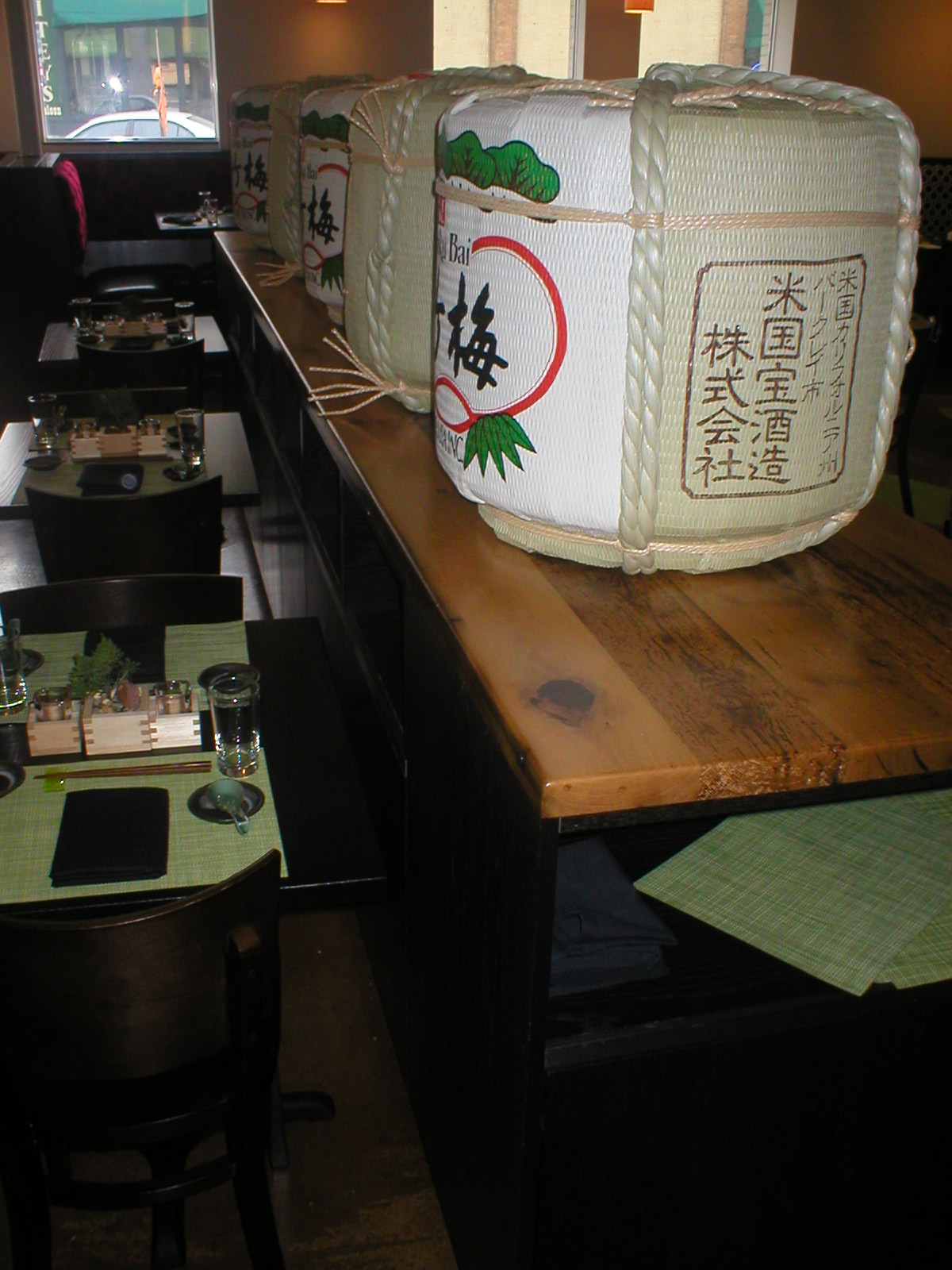
Masu’s energetic and lighthearted atmosphere, including the reclaimed antique white oak bar surface, encourages friendly interaction among chefs, customers and staff and makes Masu the place for dining, drinking and fun in Northeast Minneapolis.
 You can see other bar tops and custom furniture made from reclaimed wood at Manomin’s website.
Monday, March 28, 2011
The Pros and Cons of Reclaimed Wood Flooring vs Laminate
 |
| Antique wood flooring. |
Reclaimed wood flooring is made from reclaimed lumber that has been rescued from old buildings and recycled, refined, resawn and refinished for use as flooring, furniture and other home and commercial building uses. The original trees were cut down years ago, making reclaimed wood a green-friendly flooring option.
 Laminate wood flooring is designed to imitate hardwood flooring. It is constructed of a high-density fiberboard substrate layer, a pattern layer that is a high-resolution picture of a hardwood-flooring surface and, on top, a plastic-type, melamine wear layer. In other words, with reclaimed hardwood flooring you are walking on an actual piece of wood, whereas with laminate, you are walking on a picture of hardwood underneath a wear layer.
 |
| Decorative laminate. |
 |
| Reclaimed wood comes from interesting places, including old barns. |
Another advantage is that reclaimed wood has been dried naturally over 100+ years verses kiln-dried new wood that is forced to dry. This makes reclaimed wood more stable. Also, newly logged wood is not as dense as old growth, making the reclaimed wood that comes from old growth stronger, harder and more durable.
 |
| Vacuuming a wood floor. |
It’s true that reclaimed and new wood floors are often more expensive than laminates, but they can also add re-sale value to your home should you ever decide to sell it. Plus, real wood floors can last much longer with sanding-refinishing to renew the look. Laminate flooring cannot be refinished. If a section is damaged, it must be pulled out and a new section installed — or if the entire floor is in need of a new finish, you will have to install a completely new floor.
 |
| The sound of heels on a wooden floor. |
After considering these pros and cons, we recommend you take a look at some real-life examples. We’d be happy to have you visit us at our Manomin showroom. You’ll find that we offer a variety of gorgeous reclaimed wood flooring, including Douglas fir, yellow pine, white pine, hickory, salty fir, black walnut, oak and elm.
Thursday, March 10, 2011
Best Kept Secret #1: Manomin Resawn Timbers
According to Bill Lunn, KSTP Channel 5 Eyewitness News Anchor, Manomin Resawn Timbers is the “Best Kept Secret #1.” He even talked about it on “Twin Cities Live” the other night. You’ll want to watch the video, but following is a transcript of what Bill Lunn had to say.
We are in Hugo [MN] at Manomin Resawn Timbers. This place IS a secret because it’s kind of off the beaten path. I am a big do-it-yourselfer. I love home projects. I’m working on a mudroom right now in my house, but I also want to put in new floors. And they have some really cool old stuff here. They reclaim a lot of wood from old barns and old buildings like granaries, so I really have been dying to check this out. So come on, let’s go inside and take a look. I’m kind of looking for something extra special, and that’s why I came here to Manomin Resawn Timber, because they’ve got some really unusual wood. They’ve got Douglas fir and walnut, and I’m really interested in some kind of vintage old wood. A lot of places are just a showroom. They get their stuff from a variety of different manufacturers around the country. Here at Manomin, they do it all themselves. Check it out; this is a massive warehouse and shop. The idea of working with tools, working with saws and drills and a hammer is very cathartic to me. I can’t make my mind up right now, but I’ll bring my wife back and she’ll make my mind up for me.
Now isn’t it about time that you learn the secret and come visit us at our Manomin showroom? You’ll find us at 15152 Freeland Avenue, Hugo, MN. We offer a variety of gorgeous reclaimed wood flooring, including Douglas fir, yellow pine, white pine, hickory, salty fir, black walnut, oak and elm.
Learn more about Manomin by following us on Twitter: @manomintimbers.
We are in Hugo [MN] at Manomin Resawn Timbers. This place IS a secret because it’s kind of off the beaten path. I am a big do-it-yourselfer. I love home projects. I’m working on a mudroom right now in my house, but I also want to put in new floors. And they have some really cool old stuff here. They reclaim a lot of wood from old barns and old buildings like granaries, so I really have been dying to check this out. So come on, let’s go inside and take a look. I’m kind of looking for something extra special, and that’s why I came here to Manomin Resawn Timber, because they’ve got some really unusual wood. They’ve got Douglas fir and walnut, and I’m really interested in some kind of vintage old wood. A lot of places are just a showroom. They get their stuff from a variety of different manufacturers around the country. Here at Manomin, they do it all themselves. Check it out; this is a massive warehouse and shop. The idea of working with tools, working with saws and drills and a hammer is very cathartic to me. I can’t make my mind up right now, but I’ll bring my wife back and she’ll make my mind up for me.
Now isn’t it about time that you learn the secret and come visit us at our Manomin showroom? You’ll find us at 15152 Freeland Avenue, Hugo, MN. We offer a variety of gorgeous reclaimed wood flooring, including Douglas fir, yellow pine, white pine, hickory, salty fir, black walnut, oak and elm.
Learn more about Manomin by following us on Twitter: @manomintimbers.
Wednesday, February 16, 2011
We're Booth #263 at the St. Paul Home and Patio Show
Come see us this Thursday through Sunday at the St. Paul Home and Patio Show booth #263. They say the show is so BIG it may take more than one day to see it all!
Whether you're building a new home or sprucing up the one you have, there's something for everyone. There are hundreds of exhibits and featured displays covering 3 floors of the River Centre complex. And of course we’ll be at booth #263 to talk to you about reclaimed wood flooring and furniture.
From Kitchens to Baths, Porches to Landscaping, Interior Designs and Exterior Remodeling, it’s all at the show. Including free daily workshops and seminars on Cooking, Home Improvements, Gardens and Landscaping.
WHERE:
Saint Paul RiverCentre
WHEN:
Show hours are
Thursday, February 17 -- 12 p.m. - 9 p.m.
Friday, February 18 -- 12 p.m. - 9 p.m.
Saturday, February 19 -- 10 a.m. - 9 p.m.
Sunday, February 20 -- 10 a.m. - 6 p.m.
HOW MUCH:
Adults: $9
Youth 6-12: $2.50
Under 5: free
Save $2 on an Adult Pass!
Get ideas. Get inspired. Celebrate spring!
Whether you're building a new home or sprucing up the one you have, there's something for everyone. There are hundreds of exhibits and featured displays covering 3 floors of the River Centre complex. And of course we’ll be at booth #263 to talk to you about reclaimed wood flooring and furniture.
From Kitchens to Baths, Porches to Landscaping, Interior Designs and Exterior Remodeling, it’s all at the show. Including free daily workshops and seminars on Cooking, Home Improvements, Gardens and Landscaping.
WHERE:
Saint Paul RiverCentre
WHEN:
Show hours are
Thursday, February 17 -- 12 p.m. - 9 p.m.
Friday, February 18 -- 12 p.m. - 9 p.m.
Saturday, February 19 -- 10 a.m. - 9 p.m.
Sunday, February 20 -- 10 a.m. - 6 p.m.
HOW MUCH:
Adults: $9
Youth 6-12: $2.50
Under 5: free
Save $2 on an Adult Pass!
Get ideas. Get inspired. Celebrate spring!
Friday, February 11, 2011
Come See Us at the Minneapolis Lake Home and Cabin Show!
The Lake Home and Cabin Show is earlier this year! They moved it from April to February so that more of you can join us before the spring weather has you headed off to a cabin or lake house. After all, we Minnesotans love our lake homes and cabins!
Now in its 7th year, the Lake Home and Cabin Show is a special three-day event featuring products, services, how-to seminars and activities covering virtually every aspect of lake home and cabin ownership and the lake and cabin lifestyle.
It’s a truly unique and engaging show for those that:
1) already own lake homes or cabins
2) want to own one soon
3) want to decorate their existing home in a Northwood’s décor
Along with seeing us, your friends from Manomin, you’ll see
• Rustic and Specialty Furniture & Furnishings
• Architects, Builders & Remodelers
• Real Estate & Finance
• Sporting Gear, Outdoor Equipment & Marine
• Landscaping & Lakeshore Maintenance
• Custom Products, Accessories & Publications
• How-To Seminars & Demonstrations
WHERE:
Minneapolis Convention Center
WHEN:
Friday, February 11 -- 2 p.m. - 8 p.m.
Saturday, February 12 -- 10 a.m. - 7 p.m.
Sunday, February 13 -- 10 a.m. - 4 p.m.
HOW MUCH:
Adults: $10
Youth 5-15: $4
Under 5: free
SAVE $2! Just fill out a survey and download a coupon.
Welcome to EditPad.org - your online plain text editor. Enter or paste your text here. To download and save it, click on the button below.
Hope to see you there!
Now in its 7th year, the Lake Home and Cabin Show is a special three-day event featuring products, services, how-to seminars and activities covering virtually every aspect of lake home and cabin ownership and the lake and cabin lifestyle.
It’s a truly unique and engaging show for those that:
1) already own lake homes or cabins
2) want to own one soon
3) want to decorate their existing home in a Northwood’s décor
Along with seeing us, your friends from Manomin, you’ll see
• Rustic and Specialty Furniture & Furnishings
• Architects, Builders & Remodelers
• Real Estate & Finance
• Sporting Gear, Outdoor Equipment & Marine
• Landscaping & Lakeshore Maintenance
• Custom Products, Accessories & Publications
• How-To Seminars & Demonstrations
WHERE:
Minneapolis Convention Center
WHEN:
Friday, February 11 -- 2 p.m. - 8 p.m.
Saturday, February 12 -- 10 a.m. - 7 p.m.
Sunday, February 13 -- 10 a.m. - 4 p.m.
HOW MUCH:
Adults: $10
Youth 5-15: $4
Under 5: free
SAVE $2! Just fill out a survey and download a coupon.
Welcome to EditPad.org - your online plain text editor. Enter or paste your text here. To download and save it, click on the button below.
Hope to see you there!
Wednesday, December 29, 2010
Installing a Reclaimed Wood Floor
 |
| This casual setting works well with a Douglas fir rustic rough-sawn reclaimed wood floor. |
Television shows can make DIY look simple, or make you feel guilty for not doing it yourself, but a professional installer will make sure the job is done right the first time. Following are some high-level tips for you and your installer.
Start with the right expectations. Your reclaimed flooring will have open knots, star-checked knots, checking as well as nail and bolt holes. These marks, holes and knots help give your reclaimed wood floor its character and beauty. But there are decisions that need to be made when selecting which boards to install:
 • Size — This floor is a random-width floor and should be installed in a non-repeating pattern.
• Character — Place boards with varying degrees of character and color. Spread out the naily boards and character boards so they are not all grouped together in one area.
• Ratio — You may choose to cut out or keep in knots and character marks based on your personal preference. If you decide you want fewer character marks, your installer will need to calculate for more waste.
The back of the boards need to be set with a construction adhesive, and every knot on all boards over 5-inches wide should be dotted. We suggest using PL-400 adhesive.
Square-edge Installation
 With a square-edge installation, the layout should end on a joist. Manomin recommends a 32-inch nail pattern with alternating rows so it doesn't look like a deck with visible repeated nailing pattern. Rack (lay out) three rows at a time and randomly stagger boards by shade, while staggering the board ends by 16 inches between adjacent rows (to ensure the board ends on a joist, which is typically 16 inches on center). Wedge boards with triangular scrap pieces that have been screwed to the subfloor. After you have completed installation, set all the nails just slightly below the surface so they do not become shiny when sanding the antique floor.
We strongly recommend that the ends of the boards be predrilled prior to nailing.
Tongue-and-groove Installation
Tongue-and-groove flooring may be installed like a traditional T&G floor, but must be glued to the subfloor (any boards over 5-inches wide). PL-400 is a good construction adhesive.
Fill open knots, star-check knots, nail and bolt holes as desired with wood filler. You may want to use epoxy on areas that have a dip or a chunk of wood missing. Another option for filling knots is fiberglass resin, which can be found at most hardware stores. But mix it up in small batches, because it hardens quickly. Add color (knot-brown powder putty works great) so the resin is brown and not greenish. Then pour the mixture into open areas. It dries quickly, does not shrink and will sand like wood.
Speaking of Sanding
 Over wood can be hand planed. In fact, you can add to the effect of the antique flooring by leaving some planer marks on the wood.
Smooth planed floors are generally drum sanded. For a more distressed look, sand with a buffer instead of a drum sander, and use 60-, 80- and then 100-grit sand paper.
For original weathered-face floors, apply more sanding for a lighter-looking floor and less sanding for a darker floor. Again, buff using 60-, 80- and then 100-grit sand paper.
Recommended Finishes
Waterlox — Two coats of sealer and two coats of matte topcoat.
Rubio Monocoat (not recommended for rough floors) — Follow the manufacturer's recommendations.
Oil-based sanding sealer and poly in a satin finish — On planed smooth reclaimed wood floors, use one coat of sealer or stain and a minimum of two coats of poly. Original-face floors will require a minimum of three to four coats of poly. You may also need to epoxy or resin any rough or open spots between coats of poly.
 Manomin Resawn Timbers has a variety of antique flooring to choose from: Douglas-fir, yellow pine, white pine, hickory, end-grain tile, salty fir, black walnut, oak and elm — but the customization doesn't end there. For an extra special statement, you can ask your installer to incorporate borders and patterns to offset the floor. From herringbone to diamond or any pattern you can imagine, it can be custom designed. Custom stains and finishes will add an additional dimension to your custom floor. Manomin also offers beautiful railings and stair treads, risers, skirt boards and antique timbers to complement your reclaimed wood floors.
Tuesday, November 16, 2010
All Those Leaves Aren’t from Softwood Trees

Softwood-producing trees include yellow pine, white pine, spruce, cedar, fir, larch, Douglas fir, hemlock, cypress, redwood and yew. There are softwood coniferous forests scattered throughout the world.
The terms “hardwood” and “softwood” are mostly used to describe types of wood used in construction and furniture making. While these terms suggest that physical density determines which is which, that is not true. Both groups have a large variation in actual wood hardness, with the range in hardwood density similar to the range in softwoods. Some hardwoods, like balsa, are softer than most softwoods, while yew is an example of a hard softwood. Likewise, Douglas fir is one of the strongest woods, and it is a softwood. A tree’s lifecycle is actually most important in differentiating between hardwoods and softwoods.
Most things constructed of wood today are made from softwood, and softwoods are the primary wood used in framing wooden homes and buildings. Softwood is less expensive to use. It grows faster than hardwood and, since it can be replenished more quickly, it is thought to be a more environmentally friendly option. Of course, reclaimed softwoods are an even “greener” solution.
Manomin Reswawn Timbers offers reclaimed wood flooring in softwood as well as hardwoods like cherry, black walnut, oak and elm.
Monday, October 11, 2010
World’s Biggest (and OLDEST) Picnic Table
OK, it’s not a “picnic table,” but since we’re featuring this gorgeous table at the Manomin’s “Hog-elujah!” open house on October 14, we thought we’d call it that.

 | |
|
It’s definitely BIG and OLD. It’s nearly 40-foot long — the largest piece of slab wood in the U.S. (a single plank is 38-1/2 feet long, 4-3/4 feet wide and 4-3/4 inches thick — 870 board feet). And it’s as old as 50,000 years!
The wood comes from the ancient Kauri tree, and it’s the oldest workable timber on Earth. The trees grew for 1,000-2,000 years and then they were preserved underground for 50,000 years. How do we know this? Radio carbon dating places the age of the Ancient Kauri trees at 50,000 years old. This is the maximum limit of radio carbon dating, so it is possible that this wood is even older. Our Kauri wood is certified and guaranteed.
Harvesting Kauri wood doesn’t involve cutting any standing trees, and all of the land is redressed to its original contours, so Kauri is totally eco-friendly. It qualifies for LEED credits — perfect for green building and design.
 |
| Extraction of a Ancient Kauri Tree |
The colors and finishes are stunning! The highly polished finish is rich and luminous with warm gold and cognac color and distinctive grains. It glistens as if lit from within. This isn’t your grandma’s picnic table! The finish and size of Kauri wood makes it ideal for high-end uses such as corporate conference room tables. Manomin is one of only a few companies in the U.S. to offer the wood to trade professionals and consumers.
Following are a series of photos, but you really should see this table in person! You can view the Kauri wood during showroom hours on Friday, Oct. 15 from 9 a.m.-4 p.m. Manomin will have two Kauri slabs on display. Come talk with Manomin representatives about Kauri wood and see rough-sawn and finished slabs as well as a finished coffee table and high-top table.
Or call 651.464.1771 and see if we can make room for you at our Hog-elujah table on the 14th!
 |
Some perspective on the size of the Kauri planks. |
 |
The grain and finish are stunning. |
 |
| Beautiful shimmer in active grain. |
 |
| Rich and luminous with warm gold and cognac color. |
Tuesday, October 5, 2010
Green is Good, but Don’t be Fooled by the Wood
Every second, a slice of rainforest the size of a football field is mowed down. That’s unsustainable, particularly when you consider that rainforests help regulate temperature and weather patterns, and are critical in maintaining the Earth's limited supply of drinking and fresh water.
Growing public awareness of these environmental concerns coupled with the fact that wood floors remain a top flooring choice is creating a green building movement that has people looking for sustainable flooring alternatives. Because Manomin is in the business of resawn and reclaimed wood, this blog is going to compare reclaimed wood to the green flooring alternative bamboo.
Bamboo flooring is a very popular green choice today because it is highly renewable. The bamboo plant (technically a grass) grows faster than most of the trees used for wood flooring. It also requires less water and grows in easily managed groves. What’s more, harvesting bamboo does not kill the plant. This is all very positive for our environment. Bamboo flooring can be found at reasonable prices, too, which is a positive for homeowners’ budgets.
But bamboo flooring has a number of negatives. For one thing, there is not a Fair Trade certification for bamboo, and while the Forest Stewardship Council can certify other woods, most bamboo products have no certification. Another issue is that bamboo can't be locally sourced, so most of it is grown in China, with some bamboo plantations having displaced natural forests. Shipping bamboo from China to the United States creates a considerable amount of carbon emissions due to the product. Another environmental concern is the tilling, pesticides and chemical fertilizers used to increase bamboo yields. They contribute to soil loss and increased toxicity, resulting in a loss of native plants and animals due to the changes in habitat. Once converted into flooring, the majority of bamboo floors have formaldehyde binders in the adhesives. And bamboo floors are hard to keep looking good. It can bleach in areas that receive direct sunlight and will stain easily if not sealed properly. Plus, it can be easily scratched, dented and chipped. This may mean you have to replace your floor sooner.
Now let’s consider reclaimed wood flooring. Reclaimed lumber is rescued from old buildings and recycled, refined, resawn and refinished for use as flooring, furniture and other home and commercial building uses. The original trees were cut down years ago. Reclaimed species include Douglas fir, yellow pine, white pine, hickory, salty fir, black walnut, oak and elm. People like the character and look of reclaimed wood because it usually has a story to it, coming from an old barn, warehouse or home. There’s distress in the boards with saw marks, nail holes, wormholes and dents that when sanded and varnished create an art-like effect. It also has a warmer feeling, with rich, deep patena.
Another advantage is that reclaimed wood has been dried naturally over 100+ years verses kiln-dried new wood that is forced to dry. This makes new wood less stable. Also, newly logged wood is not as dense as old growth, making the reclaimed wood that comes from old growth stronger, harder and more durable.
Whether you are restoring a vintage house or constructing a new residence, there are many good reasons not to buy new-growth wood flooring. Hopefully this article has taught you a few things about two of your sustainable flooring options. We’d be happy to discuss them with you! Contact us today.
Growing public awareness of these environmental concerns coupled with the fact that wood floors remain a top flooring choice is creating a green building movement that has people looking for sustainable flooring alternatives. Because Manomin is in the business of resawn and reclaimed wood, this blog is going to compare reclaimed wood to the green flooring alternative bamboo.
Bamboo flooring is a very popular green choice today because it is highly renewable. The bamboo plant (technically a grass) grows faster than most of the trees used for wood flooring. It also requires less water and grows in easily managed groves. What’s more, harvesting bamboo does not kill the plant. This is all very positive for our environment. Bamboo flooring can be found at reasonable prices, too, which is a positive for homeowners’ budgets.
But bamboo flooring has a number of negatives. For one thing, there is not a Fair Trade certification for bamboo, and while the Forest Stewardship Council can certify other woods, most bamboo products have no certification. Another issue is that bamboo can't be locally sourced, so most of it is grown in China, with some bamboo plantations having displaced natural forests. Shipping bamboo from China to the United States creates a considerable amount of carbon emissions due to the product. Another environmental concern is the tilling, pesticides and chemical fertilizers used to increase bamboo yields. They contribute to soil loss and increased toxicity, resulting in a loss of native plants and animals due to the changes in habitat. Once converted into flooring, the majority of bamboo floors have formaldehyde binders in the adhesives. And bamboo floors are hard to keep looking good. It can bleach in areas that receive direct sunlight and will stain easily if not sealed properly. Plus, it can be easily scratched, dented and chipped. This may mean you have to replace your floor sooner.
Now let’s consider reclaimed wood flooring. Reclaimed lumber is rescued from old buildings and recycled, refined, resawn and refinished for use as flooring, furniture and other home and commercial building uses. The original trees were cut down years ago. Reclaimed species include Douglas fir, yellow pine, white pine, hickory, salty fir, black walnut, oak and elm. People like the character and look of reclaimed wood because it usually has a story to it, coming from an old barn, warehouse or home. There’s distress in the boards with saw marks, nail holes, wormholes and dents that when sanded and varnished create an art-like effect. It also has a warmer feeling, with rich, deep patena.
Another advantage is that reclaimed wood has been dried naturally over 100+ years verses kiln-dried new wood that is forced to dry. This makes new wood less stable. Also, newly logged wood is not as dense as old growth, making the reclaimed wood that comes from old growth stronger, harder and more durable.
Whether you are restoring a vintage house or constructing a new residence, there are many good reasons not to buy new-growth wood flooring. Hopefully this article has taught you a few things about two of your sustainable flooring options. We’d be happy to discuss them with you! Contact us today.
Monday, August 16, 2010
From Wood-fired Ovens to Wood Floors
 |
| Punch Pizza — Stadium Village |
To ensure their stores have an old-world Italian feel worthy of the authentic techniques they use to make their pizza, Punch Pizza turns to Manomin Resawn Timbers for antique timber flooring. At Manomin, we too are dedicated to the traditions and skills of our craft — milling the antique timbers with a saw mill, drying it in a kiln, planing it, fabricating it in our shop and then hand-sanding and staining it to the perfect finish.
Featured in all seven of Punch Pizza’s Twin Cities locations, Manomin most recently helped with the Punch Neapolitan Pizza – Stadium Village location at 802 Washington Ave SE in Minneapolis.

 A striking exterior door that we crafted from hand-hewn timber skins invites guest in, and a one-of-a-kind antique wooden door handle completes the look. Upon entry, our huge 22-foot long vintage timber community table greets customers, and a welcoming antique Douglas Fir floor sets the stage with gorgeous 3-inch wide planks.
  More reclaimed Douglas Fir (salvaged from old industrial warehouses) adds charm to tables and benches. Tabletops crafted out of hardwood from a central Wisconsin dairy barn built in the 1850s complements the weathered antique panel wainscoting to add to the old-world dining experience.
So we invite you to enjoy the world’s finest San Marzano tomatoes, fresh mozzarella and top-secret dough that forms the foundation of a Punch Pizza cooked to perfection in the wood-fired oven! But please, make sure you take a look around and enjoy the whole experience that Manomin helped to create.
Wednesday, February 24, 2010
Manomin Resawn Timbers is at the “Bring Fresh Ideas Home” Home and Garden Show at the Minneapolis Convention Center February 24th through the 28th. We hope to see you there. We’re in booth 2129.
Show Dates and Hours:
Wed Feb 24 - 12:00pm-9:00pm
Thu Feb 25 - 10:00am-9:00pm
Fri Feb 26 - 9:00am-10:00pm
Sat Feb 27 - 9:00am-10:00pm
Sun Feb 28 - 9:00am-6:00pm
You can get more details about the show at homeandgardenshow.com, but if you go to their “Tips and Trends – Go Green” page, you’ll see in tip number 7, Green Flooring, they’ve left out an important green flooring option: reclaimed wood flooring! Of course we’re biased, but we think wide plank flooring that is milled from reclaimed antique timbers is the best green solution out there!
Reclaimed wood flooring has both environmental and aesthetic benefits, inspiring new and innovative style for homes while also preserving the traditional warmth and durability of natural wood.
The Home and Garden Show highlight, Timber Barn Bungalow, illustrates what a modern, rustic attitude can do for a home. We invite you to stop by booth 2129 and talk to us about the benefits of going green with reclaimed wood flooring. Whether you choose a rustic or contemporary finish, the benefits of a more stable, harder wood with tighter grains are strongly worth considering.
You can also visit Kitchen Conversations to read a blog about our time with Holiday Kitchens discussing the advantages of recycling timber and the phenomenal results that can be achieved. Or stop by our Manomin Resawn Timbers Web site to learn more about the green-friendly antique flooring available.
Thanks
Sarah and Mark
Manomin Resawn Timbers
Show Dates and Hours:
Wed Feb 24 - 12:00pm-9:00pm
Thu Feb 25 - 10:00am-9:00pm
Fri Feb 26 - 9:00am-10:00pm
Sat Feb 27 - 9:00am-10:00pm
Sun Feb 28 - 9:00am-6:00pm
You can get more details about the show at homeandgardenshow.com, but if you go to their “Tips and Trends – Go Green” page, you’ll see in tip number 7, Green Flooring, they’ve left out an important green flooring option: reclaimed wood flooring! Of course we’re biased, but we think wide plank flooring that is milled from reclaimed antique timbers is the best green solution out there!
Reclaimed wood flooring has both environmental and aesthetic benefits, inspiring new and innovative style for homes while also preserving the traditional warmth and durability of natural wood.
The Home and Garden Show highlight, Timber Barn Bungalow, illustrates what a modern, rustic attitude can do for a home. We invite you to stop by booth 2129 and talk to us about the benefits of going green with reclaimed wood flooring. Whether you choose a rustic or contemporary finish, the benefits of a more stable, harder wood with tighter grains are strongly worth considering.
You can also visit Kitchen Conversations to read a blog about our time with Holiday Kitchens discussing the advantages of recycling timber and the phenomenal results that can be achieved. Or stop by our Manomin Resawn Timbers Web site to learn more about the green-friendly antique flooring available.
Thanks
Sarah and Mark
Manomin Resawn Timbers
Subscribe to:
Posts (Atom)